Casinos with Bingo in New Zealand: How They Work
 Available in US
Online bingo rooms differ in game formats and licensing, while their casino games, payment options and bonus terms can shape the experience.
Table of Contents
- How Online Bingo Rooms Work for New Zealand Players
- What to Check When Comparing Bingo Casinos
- Bingo Formats, Tickets and Winning Patterns
- Bingo Bonuses and the Wagering Terms to Read
- What a Bingo Casino Offers Beyond the Name
- How to Play a Bingo Round and Track Your Spend
- New Zealand’s Online Casino Licensing Transition in 2026
- Payments and Banking for Bingo Casino Sites
- How Bingo Fits Alongside Online Casino Games
- Playing Casino Bingo in New Zealand: What the Law Says
How Online Bingo Rooms Work for New Zealand Players
Online bingo is available to people in New Zealand through rooms licensed offshore. These services host bingo games online, so you can take part from within the country without visiting a physical venue. The distinction that matters is where the room is licensed: being able to access a service from New Zealand does not mean it holds a New Zealand gambling licence.
Offshore licensing and New Zealand licensing are separate things. An offshore licence is issued by an authority outside New Zealand and applies under that authority’s framework. It does not become a local licence simply because New Zealand residents can visit the site or play there. Treating those two points as interchangeable can give you the wrong impression about who regulates the service.
The available online rooms offer several kinds of bingo, including 75-ball, 90-ball and speed bingo. That range means the word “bingo” can refer to different online games rather than one identical experience everywhere. The room is the online setting in which a game is offered; it does not change the location or origin of the licence behind the service. The formats themselves have different ticket structures and patterns, so they are best considered separately rather than assumed to work alike.
If you’re looking for casinos with bingo in New Zealand in 2026, use this list as a starting point for checking which options suit you. Confirm that bingo is available to you before signing up.
License: Malta Gaming Authority, licence no. MGA/B2C/394/2017 N1 Casino lists a Malta Gaming Authority licence, no. MGA/B2C/394/2017. This gives you a specific licensing detail to check when assessing the casino.
License: Tobique Gaming Commission, licence no. 0000002 Ricky Casino lists a Tobique Gaming Commission licence, no. 0000002. You can use that detail as a starting point for checking its licensing information.
License: Tobique Gaming Commission, licence no. 0000064 Neospin lists a Tobique Gaming Commission licence, no. 0000064. The licence number is a concrete detail for you to verify when considering the casino.
License: 07017519840 · Payout speed: 1-3 business days Zotabet lists licence number 07017519840 and a payout speed of 1–3 business days. These details give you licensing and payout information to consider.
License: Malta Gaming Authority, licence no. MGA/B2C/370/2017 Play Grand lists a Malta Gaming Authority licence, no. MGA/B2C/370/2017. You can check this licence detail as part of your assessment.
Payout speed: 1-3 business days Wintino lists a payout speed of 1–3 business days. This gives you a stated timeframe to consider when reviewing its payment information.
License: Tobique Gaming Commission, licence no. 0000091 7Bit Casino lists a Tobique Gaming Commission licence, no. 0000091. You can use this specific licence detail when checking the casino.
License: Curaçao Gaming Authority, licence no. OGL/2024/165/0185 BitStarz lists a Curaçao Gaming Authority licence, no. OGL/2024/165/0185. This provides a specific licensing detail for you to verify.
Payout speed: 1-3 business days Lamabet lists a payout speed of 1–3 business days. You have a stated timeframe to consider when reviewing its payment information.
You may also see bingo presented within a broader online casino environment. The label on a site can describe its overall entertainment offering, while bingo is one of the activities available there. For a player, it is useful to keep the product and the regulatory status distinct: a site may provide online bingo to New Zealand residents under an offshore licence, but that does not make the service part of New Zealand’s locally licensed casino market.
For adults aged 18 or over, playing at an offshore online casino or bingo site from New Zealand is permitted. That includes using Jet Bingo from within the country. Permission to play, however, is not the same as local oversight of the operator. A player can be acting lawfully while using a service that is not licensed by a New Zealand regulator. This is a practical distinction, not a contradiction.
It also helps to separate access from assurance. A site loading in your browser, displaying bingo rooms or accepting visitors from New Zealand tells you that the service is reachable; it does not, on its own, establish that a New Zealand authority has licensed it. Likewise, an offshore licence should not be described as a New Zealand licence. These terms refer to different regulatory arrangements, and the difference affects what you should understand about the service you are using.
If you are considering real-money bingo, keep the setting in mind before treating an online room as equivalent to a local venue. You are using a service provided from offshore, even when you are sitting at home in New Zealand. The fact that play is allowed for adults does not mean every aspect of the room is supervised under New Zealand licensing. Nor should the presence of casino games alongside bingo be taken as evidence of local authorisation.


Free-to-play bingo and real-money play are also not the same activity. A free option, where a room offers one, may let you experience its online presentation without wagering. Real-money play involves money at stake. The availability of one does not establish the availability or regulatory position of the other, so check what mode you are entering rather than assuming that all rooms or games operate on the same basis.
The central point is straightforward: New Zealand residents can access offshore-licensed online bingo rooms, and adults aged 18 or over are allowed to play at those services from within the country. But access from New Zealand is not proof of a New Zealand licence. Keeping those statements separate gives you a clearer picture of what “online bingo” means in this market and avoids mistaking an offshore service for a locally regulated one.
What to Check When Comparing Bingo Casinos
A useful comparison starts with what you can verify on the room’s own pages, not with a claim that one site is the best for everyone. Look for clear information about the bingo games available, their published return figures and the rules that affect how a round is settled. If key details are difficult to find or are described only in broad promotional language, you have less to work with when deciding whether the room suits you.
- Verify the specific RTP for the game you intend to play
- Check if rules and prize information are easy to locate
- Compare room formats against your preferred pace
- Assume a broad room RTP applies to every specific game
- Rely on promotional language instead of published rules
- Assume a longer menu of formats means a better fit
Read return information in context
Return to player (RTP) figures can help you compare published information, but they are not a prediction of what you will win in an individual session. A specialist review reports that published RTPs for online bingo in rooms supplied by Pragmatic Play, Playtech and Microgaming fall in the 85%–92% range. Treat that as a reported range, not a guarantee for every game or a promise about your results.
Check whether the room gives a figure for the particular bingo game you intend to play, and whether it explains what the figure applies to. A broad statement about the room’s bingo offering may not tell you the return for a specific game. Where the information is not clearly tied to a game, avoid assuming that a figure applies across the whole room. RTP is one comparison point; it does not tell you how often prizes are won, how large they will be or whether a particular session will be profitable.
It is also worth checking whether the rules and prize information are easy to locate before you join a game. You should be able to understand what counts as a win and how the stated prize is awarded. If you cannot tell what the published information refers to, it is sensible not to treat it as a meaningful basis for comparison.
Match the room to your pace
A room may offer several bingo formats, but a longer menu is not automatically a better fit. Consider how much time you want to give a round and whether you prefer a more measured pace or a quicker one. The game descriptions should make it possible to see what is on offer before you commit to playing.

Pay attention to whether the room makes it straightforward to distinguish one format from another. Clear labels and accessible rules help you decide whether the available choice fits your preferences. If the descriptions leave you unsure about how a game proceeds, pause to read its rules rather than relying on its name or promotional wording.
The pace of play also affects how you experience a session. A format that feels comfortable when you are focused may be less suitable when you are tired or distracted. Decide in advance what kind of round you want, and do not assume that a room’s most prominent option will be the right one for you.
Look for usable, consistent information
Compare how readily you can find the information you need, rather than judging a room by the volume of claims on its landing page. Useful details should be presented plainly and consistently: game descriptions should match the rules, and return information should be specific enough to interpret. If separate pages appear to describe the same game differently, seek clarification before relying on either description.
You can also consider whether the room makes it easy to review the relevant details before starting a round. A comparison is more useful when you can check the game information without having to make a deposit or begin playing first. Give greater weight to clear, game-specific explanations than to general statements about having a large selection or attractive prizes.
Uses a five-by-five card where wins are based on completing specified patterns.
Features a ticket with three rows and nine columns, typically involving three prize stages.
Contains sixteen numbers and uses a unique range of winning patterns.
Also known as 30-ball bingo, using a three-by-three card for fast-paced rounds.
There is no single measure that makes one online bingo casino the right choice for every player. A room’s published return information, the formats it offers and the clarity of its rules are practical points to weigh together. Choose according to the pace and information you are comfortable with, and treat unclear claims as a reason to look more closely rather than as proof of value.
Bingo Formats, Tickets and Winning Patterns
Bingo formats differ in more than the number of balls used. The ticket layout affects what counts as a win, while the prize pattern determines how a round progresses. When you compare bingo casino games, look at the structure of each format rather than assuming that every ticket follows the same rules.
75-ball bingo: pattern-based wins
North American 75-ball bingo uses a five-by-five card. Its wins are based on completing a specified pattern, rather than reaching a sequence of line prizes. Depending on the game, a winning pattern might form a letter, a shape or a blackout across the card.
That variety changes the objective from one round to another. A letter pattern asks for a particular arrangement; a shape has its own outline; a blackout requires the whole card to be covered. The format can therefore feel less like progressing through set prize stages and more like working toward the pattern named for that game.
Before entering a round, check which pattern qualifies. Two games using the same card size may not have the same target, and recognising a familiar five-by-five layout does not tell you what the prize condition is.

90-ball bingo: three line stages
The 90-ball format uses a ticket arranged in three rows and nine columns, with fifteen numbers on each ticket. Its prize structure is commonly described through three stages: one completed line, two completed lines, and a full house. A full house means completing the ticket’s required numbers.
These stages give the round a clear progression. A line prize may be reached before the later tiers, so the round does not have to depend on a single final outcome. The ticket’s layout and the tier names are useful clues, but the room’s rules still determine exactly how it awards prizes.
This is one of the more familiar formats in online bingo casino games. Its appeal is partly the staged structure: you can follow the possibility of an earlier line prize while the round continues toward two lines or a full house. That is different from a pattern-led game, where the specific arrangement is the central condition.
80-ball bingo: more pattern possibilities
An 80-ball ticket contains sixteen numbers and uses a different range of winning patterns from the other formats described here. The smaller number of numbers on the ticket does not, by itself, tell you what a particular game will pay for. Its pattern rules are the important distinction.
Some 80-ball games may define a target around a particular arrangement, but the available pattern can vary by game. Read the displayed win condition before choosing a round; the number of balls alone is not a reliable guide to the prize structure.
Compared with 90-ball bingo, the format is not organised around the same one-line, two-line and full-house progression. Compared with 75-ball bingo, it also has its own ticket structure and pattern range. Treating these as interchangeable can lead you to expect a win condition that the game does not use.
Bingo formats are distinguished by their ticket layout, winning conditions, and prize stages.
Speed bingo: a compact, fast round
Speed bingo, also called 30-ball bingo, uses a three-by-three card and has a single full-house prize. A specialist review describes rounds lasting 60 to 90 seconds. That is a source-specific description of this fast format, not a promise about the duration of every game.
With only one prize stage, speed bingo differs from 90-ball games that can award prizes for one line and two lines before a full house. Its compact ticket also sets it apart from the five-by-five 75-ball card and the sixteen-number 80-ball ticket. The round is built around completing the card, rather than a series of line tiers or a varied pattern target.
For an online bingo game, the format name is only a starting point. Check the ticket layout, the winning condition and the prize stages shown for the specific round. Those details tell you whether the game is pattern-based, staged by lines, or focused on one full-house result.
Bingo Bonuses and the Wagering Terms to Read
A bingo bonus can add funds or playing credit to an account, but the displayed offer is only one part of its value. The wagering requirement determines how much qualifying play must take place before bonus-related winnings can be withdrawn. If that requirement is high relative to the bonus, meeting it may take more play than you intended. Treat the promotion as restricted credit until you have read the conditions attached to it.
A specialist affiliate review describes bingo-bonus wagering requirements in a range from 3x to 10x the bonus amount. That is a reported range, not a promise that every room offers terms within it or that a current promotion will match it. The calculation also matters: a requirement based on the bonus alone differs from one based on the bonus plus your deposit. Read the wording to see which amount is multiplied. Do not assume the most favourable interpretation.
For instance, a promotion described as a multiple of the bonus amount requires qualifying play calculated from that bonus, rather than simply asking you to deposit and then withdraw. The multiplier is not the same as a cash fee, and completing it does not necessarily mean every balance is immediately available. The terms explain what counts as qualifying play and what restrictions remain. If the calculation is unclear, pause before accepting the offer.
Read the conditions, not just the headline
A welcome banner may emphasise a match percentage or a maximum value, while leaving the practical restrictions in linked terms. Before opting in, look for how wagering is calculated, which games count towards it, and whether the offer has a time limit or other play restrictions. Check what happens if you decline the bonus, too: accepting promotional credit can mean accepting conditions that would not apply to a cash-only balance.
A specialist affiliate review gives a typical welcome-deal example for Kiwi players: a 100% match on the first deposit, with a maximum of roughly NZ$300 in equivalent value. This is an example reported by that type of review, not a standing offer across bingo rooms. The actual availability, amount and terms can change. A matching deposit also does not remove the wagering requirement; the bonus conditions still determine what qualifying play is needed before related winnings can be withdrawn.
Attention Always read the specific wagering requirements, as they may be based on the bonus amount alone or the bonus plus your deposit.
A no-deposit offer, if one is presented, should be checked just as carefully. The absence of an initial deposit does not by itself mean the bonus is unrestricted or that winnings can be withdrawn without conditions. Look for the wagering basis and any requirements attached to claiming or using the credit. If those details are difficult to find, the headline alone is not enough to judge what the offer permits.
The same care applies to any bonus bingo promotion framed around free play or extra credit. Separate the promotional amount from money you have deposited, then identify the exact balance to which the wagering multiplier applies. Read the conditions before opting in, rather than relying on a short banner or a summary. A bonus can be useful only if its terms are clear to you and the required play fits the amount you are prepared to spend.
What a Bingo Casino Offers Beyond the Name
“Bingo casino” describes a combination of products, not necessarily a separate kind of gambling business. Bingo may be one part of a wider casino offering, alongside other casino verticals. The important distinction is that the bingo games do not sit in an entirely separate licensing category: bingo products fall under the same licensing umbrella as the casino’s other verticals.
That shared umbrella can make the label easier to understand. A site may present bingo as a distinct area of its entertainment offering, with its own lobby or game selection, while the underlying regulatory framework treats it as part of the broader casino operation. The product’s name and the way it is displayed do not, by themselves, tell you that it has a separate licence.
This matters when you are reading descriptions of a site. A dedicated bingo section is a way of organising products for players; it is not evidence that bingo is regulated independently from the rest of the casino. Equally, seeing bingo listed beside other casino games does not mean that every product has a different regulatory status. The relevant point is the licensing umbrella that applies to the casino’s verticals.
The same distinction helps avoid a common misunderstanding: a site can specialise in bingo from a player’s perspective without bingo becoming a separate regulatory island. Its public-facing identity may centre on bingo, but the product still belongs within the broader category of casino verticals. Conversely, a casino that offers bingo among a wider set of products does not make bingo less of a distinct entertainment choice for someone who wants to play it.
For you, the practical takeaway is modest but useful. Treat “bingo casino” as a description of what the site offers, rather than as a statement about a special licence reserved for bingo. Product labels explain the menu; they do not establish the scope or status of the operator’s licensing. That distinction is particularly useful when a site’s branding makes one type of game seem separate from its wider casino offer.
It also keeps the focus on what the label can actually tell you. It signals that bingo is part of the product mix, but it does not answer every question about how the operator is authorised. The bingo offering and the other casino verticals belong under one licensing umbrella; the label alone should not be read as proof of a separate permission for bingo.
How to Play a Bingo Round and Track Your Spend
In five-line bingo, your ticket has a five-by-five grid containing 25 numbered squares. Numbers are drawn from 1 to 75, and there is no free square in the centre. As numbers are called, you mark any that appear on your ticket. A room may offer automatic marking, which tracks matches for you and can flag when your ticket reaches an eligible result. It can reduce the chance of overlooking a match, but it does not change which numbers have been drawn or the rules for winning.
The round moves through five prize stages: one completed line, then two, three, four and finally five lines. Five completed lines are also called a full house. Check how the room defines a line before joining, because the winning condition depends on its rules. In a room that counts horizontal rows, for instance, two completed rows count as two lines; three marked numbers in another row do not make that row complete.
The lines needed for a prize must be on the same ticket. If you have several tickets, you cannot combine a completed row on one with a completed row on another to reach a two-line stage. This distinction matters when you are following more than one card: count each ticket separately, even if the interface displays them together.
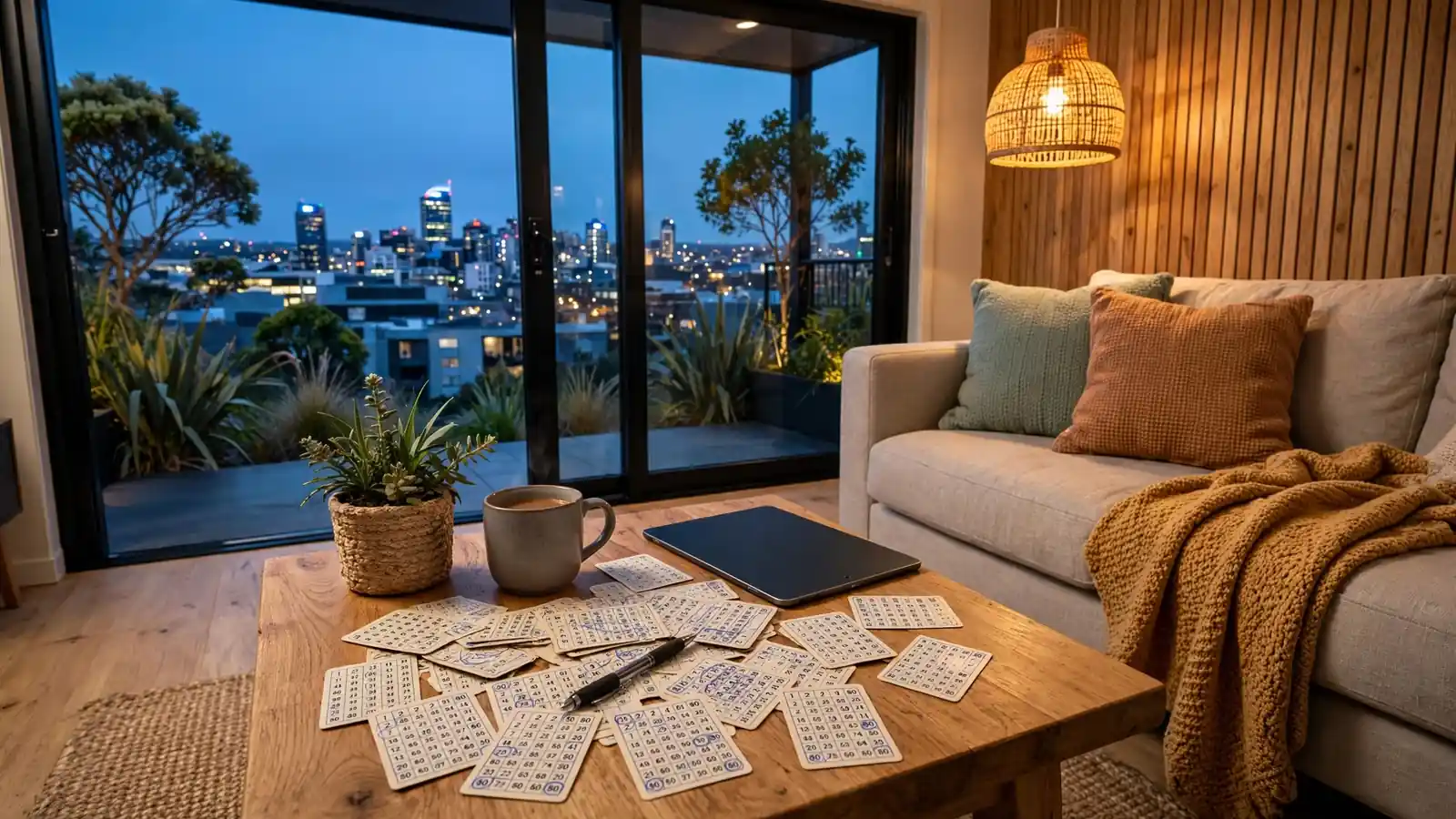
A ticket may be eligible for more than one prize stage if the room’s rules allow it. For example, a ticket that reaches a later stage may also meet the conditions for an earlier one, but whether both prizes are paid depends on the published rules. Several eligible tickets may also share a prize. Read the room’s explanation of prize allocation before playing for money; a displayed match is not enough on its own to establish how a prize is divided.
Keep the ticket cost visible
The quickest way to follow your spend is to multiply the ticket price by the number of tickets selected, then by the number of rounds you intend to play. A specialist review gives a hypothetical calculation: at NZ$0.40 per ticket, three tickets cost NZ$1.20 for one round, and ten rounds at that same selection cost NZ$12. This is an illustration of the arithmetic, not a statement of a standard ticket price.

If you switch the number of tickets or the price between rounds, recalculate rather than carrying forward the previous total. Automatic marking can help you track matches and eligible results, but it does not track your overall spend. Keep that total separate, and check it before confirming another round. A clear view of both the selected tickets and the round cost makes it easier to notice when your session is going beyond the amount you intended.
New Zealand’s Online Casino Licensing Transition in 2026
New Zealand is moving from a market without a domestic online casino licensing system to one overseen through a national framework. The Department of Internal Affairs (DIA) is the government body responsible for gambling regulation, and it is leading the staged introduction of the new regime.
The Online Casino Gambling Act 2026 came into force on 1 May 2026. It creates the country’s first domestic licensing system for online casino gambling. A specialist market review describes the legislation as providing for a maximum of 15 online casino licences. That is a cap on the number of licences, not confirmation that all places have been awarded or that every site currently available to New Zealanders holds one.
Licensing Transition Details
The Online Casino Gambling Act 2026 introduces a domestic licensing system. A transition period runs from 1 May to 1 December 2026, with full operation expected in 2027.
The change is not immediate. The Act sets a transition period from 1 May to 1 December 2026. Online casino providers that were already serving people in New Zealand before the start of that period may continue operating during it, subject to the transitional rules. The DIA says the regime is being rolled out in stages, with full operation expected in 2027.
That timing matters when you read claims about casinos offering bingo. A site being accessible in New Zealand, or having operated here before the new law took effect, is not the same as holding a New Zealand licence. During the transition, the applicable status depends on the provider and the transitional provisions; the domestic licensing system is not yet fully operational.
The framework also changes what happens after the transition. Providers that have not applied for a licence must stop conducting online casino gambling in New Zealand by 1 December 2026. The wider regulatory change is therefore about who may continue serving the market and under what domestic oversight, not about the bingo games themselves.
For now, treat licensing language carefully: distinguish a provider’s current transitional position from a licence under the new regime. The DIA’s staged timetable places the full system in 2027, so a claim that a room is already “New Zealand licensed” should not be taken at face value without confirmation that a licence has actually been issued.
Payments and Banking for Bingo Casino Sites
Payment methods are worth checking before you decide whether to create an account. A specialist payment-method review reports that New Zealand players use several routes for deposits at casino sites, including Worldline and Blink, direct bank transfers from ASB, ANZ, BNZ and Westpac, Visa or Mastercard debit cards, and e-wallets such as Skrill, Neteller and MuchBetter. These are reported options, not a promise that every bingo room will accept each one. The methods shown at the payment stage are the ones relevant to that particular site.

POLi is no longer among the available routes. A specialist review of New Zealand casino payments reports that this bank-direct service, which had been prominent for casino deposits for more than a decade, was discontinued in 2024. If you relied on it for online payments, you will need to look at the alternatives displayed by the site rather than assume a bank-transfer option works in the same way.
The name of a payment method alone does not tell you how a transaction will be handled. Before entering details, check that the provider and the account name match what you intend to use, and read the instructions on the deposit screen. For a direct bank transfer, confirm the listed bank route and any reference details carefully. For a card or e-wallet, check that the service you use is specifically shown as accepted; a logo elsewhere on a page may not establish that it is available for deposits.
Keep a record of the amount and the payment route you choose. If a deposit does not appear in the account, that record can help you explain what happened when contacting the site’s support team or payment provider. Do not send another payment simply because the first one is not immediately visible; first check the account history and the site’s instructions.
Payment options can change, so check them at the point you are ready to fund an account. This is particularly important if you have used the same route elsewhere: availability on one site does not mean it is supported by another.
How Bingo Fits Alongside Online Casino Games
Bingo can sit within a broader online casino offering rather than operating as a separate kind of account. A casino room may present bingo alongside its other gambling products, giving you a single place to access different categories. That convenience does not make the products interchangeable: bingo has its own rounds and prize structure, while the wider casino may include other forms of play. Keep the distinction clear when you look at a site’s overall presentation.
The label “casino” also does not tell you how bingo results are calculated or what a particular game returns. For that, look for information tied specifically to the bingo product. A published return-to-player figure, or RTP, is a theoretical measure across many rounds, not a prediction of what you will receive in one session. It cannot tell you whether a particular ticket will win, and it should not be treated as a personal spending target.
A specialist review reports that published online bingo RTPs for rooms supplied by Pragmatic Play, Playtech and Microgaming generally fall within a range of 85% to 92%. That is a reported range, not a guarantee for every room or game. If a site displays an RTP, check that it applies to the bingo product you are considering rather than to another casino category. A figure shown for one title should not be assumed to cover every bingo room on the same platform.
The wider casino setting can make it easy to move between products without pausing to reassess. Before switching, take a moment to check what you have selected and whether the information shown relates to bingo. An RTP describes theoretical returns over extended play; it does not remove the possibility of losing the amount you choose to spend.
Bingo’s place in a casino lobby is therefore a matter of product range, not evidence that all games share the same mechanics or return profile. Treat each category on its own terms, and use only the published information that clearly applies to the bingo product.
Playing Casino Bingo in New Zealand: What the Law Says
For New Zealand residents, playing bingo through an offshore-licensed room is not prohibited under the Gambling Act 2003. That is the key distinction for anyone considering online casino bingo: the law’s position on a player using an offshore service is not the same as the service holding permission from a New Zealand regulator.
An offshore licence is issued by a jurisdiction outside New Zealand. It does not become a New Zealand licence simply because the room can be accessed from here or accepts New Zealand players. So, when a site describes itself as licensed, check which authority issued that licence and do not read the claim as evidence of domestic authorisation.
This matters because “not prohibited for the player” is a limited statement. It does not mean that every offshore room has been approved by New Zealand, or that the New Zealand government supervises its bingo games. Nor does it guarantee that a dispute with the operator can be resolved through a New Zealand regulator. The law’s position on playing should not be mistaken for a guarantee about the service.
If you decide to use an offshore room, keep those points separate: the player’s legal position in New Zealand, the operator’s licence in another jurisdiction, and the practical protections available if something goes wrong. Read the room’s own licensing information carefully, and avoid relying on a general “licensed” label where the issuing authority is not clear.
In short, New Zealand residents are not prohibited from playing bingo at offshore-licensed rooms under the Gambling Act 2003. But that does not make those rooms New Zealand-licensed casinos. A clear understanding of that difference helps you assess what the legal statement does—and does not—tell you before you play.
Are online casinos licensed in New Zealand in 2026?
Online bingo and casino services available to New Zealand players operate under offshore licences, which are not New Zealand licences. The new licensing regime is being introduced in stages and is expected to be fully operational in 2027.
Is online bingo legal for players in New Zealand?
Yes. Adults aged 18 or over may play at offshore-licensed bingo sites from New Zealand; this does not mean those sites hold a New Zealand licence.
What RTP should I expect from online bingo games?
Published RTPs for bingo games supplied by Pragmatic Play, Playtech and Microgaming generally fall between 85% and 92%. Check the figure for the specific game, as RTP is not a guarantee of your results.
Can I play online bingo for real money in NZ?
Yes. Adults aged 18 or over can play for real money at offshore-licensed bingo rooms from New Zealand.
How do I deposit at an NZ bingo site after POLi closed?
POLi was discontinued in 2024. You can use options such as Worldline, Blink, direct bank transfer from ASB, ANZ, BNZ or Westpac, Visa or Mastercard debit, or e-wallets including Skrill, Neteller and MuchBetter.
Created by the ”Casino Expert NZ” editorial team.