Playing Keno in New Zealand: Rules and Payouts
 Available in US
See how chosen numbers differ from drawn numbers, and how rules and prize tables shape the result.
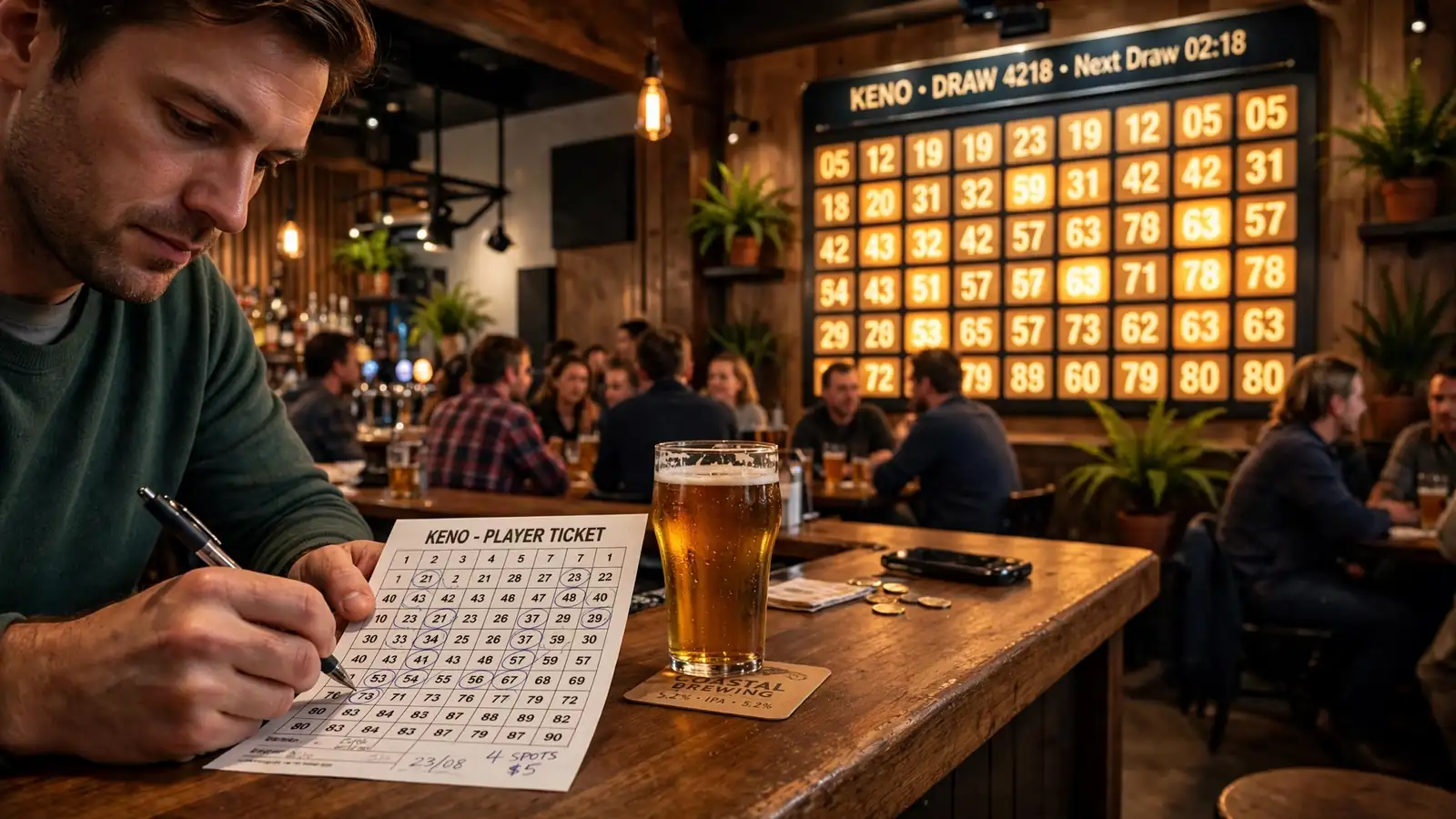
Table of Contents
- How a Keno Draw Works
- When You Can Play Daily Keno
- Keno Rules and What Happens to Unclaimed Prizes
- Keno in New Zealand: Where and How to Play
- How Many Numbers Do You Need to Match to Win?
- How to Read a Keno Prize Table
- Keno Payout Charts: What They Can and Cannot Tell You
- Keno Winners and Claiming a Prize
- Does One Keno Draw Affect the Next?
- Is There a Set Maximum Keno Win in New Zealand?
How a Keno Draw Works
Keno is built around two sets of numbers: the numbers you select for your entry and the numbers drawn for the game. In Keno NZ, the draw takes twenty numbers from a pool of eighty. Your task when setting up an entry is to choose which numbers to include; the draw then produces its own set. The basic mechanic is the same whether you are learning how to play Keno in New Zealand at a general level or looking at a particular version of the game.
You do not choose how many numbers the draw produces. In a twenty-number Keno game, exactly twenty are drawn. Your choice concerns the size of your own selection, and that can vary by game format. Keeping those two figures separate helps: one describes the draw, while the other describes your entry. They are related when an outcome is assessed, but they are not the same thing.
For standard Keno, the stated selection range is one to ten numbers. Online Keno is described differently in one account, which gives a range of four to twenty selections. There is a direct disagreement between those descriptions: another version says Keno players can choose one to ten numbers, without giving a separate online range. Do not treat the two ranges as if they were one consistent rule. If the format you are considering is online, check the selection options shown for that specific game before settling on a number of picks.
Choosing where to play keno in New Zealand in 2026 can involve checking what information is available about each operator. Use these brief verdicts as a reference when considering your options.
License: Malta Gaming Authority, licence no. MGA/B2C/394/2017 N1 Casino lists a Malta Gaming Authority licence, number MGA/B2C/394/2017. You can use that detail as a starting point when reviewing the operator.
License: Tobique Gaming Commission, licence no. 0000002 Ricky Casino lists a Tobique Gaming Commission licence, number 0000002. You can consider this licensing detail when reviewing the operator.
License: Tobique Gaming Commission, licence no. 0000064 Neospin lists a Tobique Gaming Commission licence, number 0000064. This gives you a specific licensing detail to check.
License: 07017519840 · Payout speed: 1-3 business days Zotabet lists licence number 07017519840 and a payout speed of 1–3 business days. These are useful details for you to consider when reviewing the operator.
License: Malta Gaming Authority, licence no. MGA/B2C/370/2017 Play Grand lists a Malta Gaming Authority licence, number MGA/B2C/370/2017. You can take this licence information into account when considering the operator.
Payout speed: 1-3 business days Wintino lists a payout speed of 1–3 business days. This gives you a stated timing detail to consider.
License: Tobique Gaming Commission, licence no. 0000091 7Bit Casino lists a Tobique Gaming Commission licence, number 0000091. You can use this as a specific detail when assessing the operator.
License: Curaçao Gaming Authority, licence no. OGL/2024/165/0185 BitStarz lists a Curaçao Gaming Authority licence, number OGL/2024/165/0185. This gives you a licensing detail to review.
Payout speed: 1-3 business days Lamabet lists a payout speed of 1–3 business days. You can consider this stated payout timing when reviewing the operator.
The practical sequence is straightforward. First, decide how many numbers you want in your selection, within the range offered by the version you are playing. Then choose the individual numbers for your entry. Once the draw takes place, its twenty numbers can be compared with your selection. The draw does not add numbers to your entry or change the numbers you chose; it produces the set against which your entry is assessed.
This distinction matters because “selecting numbers” can sound like choosing the draw itself. You are not doing that. You are choosing a smaller set, or in some versions a larger set, from the pool available to the game. The draw remains a separate process. A selection of one number and a selection of several numbers are different entry sizes, but neither changes the fixed number of drawn results in a twenty-number game.
When you look at the screen or entry slip, focus on the choices the game actually presents rather than assuming every Keno format has identical controls. A standard game may use the one-to-ten range, while online descriptions may show the alternative four-to-twenty range. The wording around online Keno is inconsistent, so it is sensible to confirm the permitted selection count in the specific game interface. That is a check on the rules of the format, not a way to influence the draw.
The same mechanics apply if you are trying to understand how Keno works in New Zealand before choosing an entry: the game has a pool of eighty, the draw selects twenty, and your entry contains the numbers you chose within that format’s permitted range. You do not need to make the selection range match the number drawn. Those are separate parts of the game, and the available range is the detail most likely to differ between standard and online versions.
It can help to think of the entry as a prediction set rather than a sequence. The numbers you select do not have to be written in the order in which they might be drawn, and the draw’s result is its own collection of twenty numbers. What matters mechanically is which numbers are in each set, not the order in which you happened to mark or view them. No special pattern is required by the mechanics described here.
If you are new to Keno, begin by identifying whether the game is standard or online and then read its selection controls carefully. Do not assume that an online option permits the same number of picks as a standard entry, or that every description uses the same range. The difference is important before you submit anything: the number of selections determines the shape of your entry, while the draw always supplies twenty numbers in a twenty-number game. Understanding those separate steps gives you a clear basis for reading the game without confusing your choices with the draw itself.
- Check the specific selection options for your chosen game format.
- Confirm the permitted selection count in the specific game interface.
- Match your plans to one of the four scheduled draw times.
- Assume every Keno format has identical controls or selection ranges.
- Start the entry process exactly at the scheduled draw time.
- Assume online Keno permits the same number of picks as standard entries.
When You Can Play Daily Keno
Keno NZ has four scheduled draws each day: 10 am, 1 pm, 3 pm and 6 pm. If you are planning a ticket around a particular draw, the important point is the closing time: entry for that draw closes at its scheduled time.
That means the draw time is also the entry deadline, not a suggested time to begin making arrangements. A ticket needs to be entered before the relevant draw reaches its scheduled time. At 1 pm, for instance, entry for the 1 pm draw closes; the same rule applies at 10 am, 3 pm and 6 pm.
The gaps between draws are not all the same. There are three hours between the 10 am and 1 pm draws, two hours between 1 pm and 3 pm, and three hours between 3 pm and 6 pm. If you are trying to keep track of a particular entry, check which draw time it is intended for rather than relying on a general sense of when Keno is available.
A practical way to avoid a last-minute mistake is to decide on the draw you want before its closing time and leave enough room to complete your entry. Do not assume that beginning the process at the scheduled time will get a ticket into that draw: entry closes then. If the timing is close, confirm that the entry has been accepted before treating it as part of that draw.

The four daily times give you several scheduled opportunities across the day, but they do not make the closing rule flexible. Each draw has its own stated time, and its entry window ends at that time. This is especially worth remembering if you are checking a schedule while busy or returning to an entry later; the time attached to the draw, rather than the time you first considered playing, determines the deadline.
For a simple daily routine, keep the four times in mind and match your plans to one of them. The morning draw is at 10 am, followed by draws at 1 pm, 3 pm and 6 pm. Whichever one you have in mind, submit before its scheduled time. Once that time arrives, entry for that draw is closed.
Keno Rules and What Happens to Unclaimed Prizes
For Keno in New Zealand, the entry deadline is tied to the scheduled draw: entries close when that draw is due to take place. If you intend to enter a particular draw, treat its stated time as the cutoff rather than assuming a ticket can still be added once the draw is under way. A ticket intended for a later draw is a separate entry; the deadline for one draw does not extend because you missed it.
This is a straightforward rule, but it matters when you are entering close to draw time. Allow enough time to complete the entry before the cutoff, and check that the ticket is for the draw you intended. Do not rely on a website or retailer being able to accept an entry after the scheduled time. The rule gives you a clear boundary, but it does not establish what happens if a particular entry is interrupted or fails to go through; avoid assuming that an incomplete attempt counts.
A specialist affiliate review reports that an unclaimed Keno prize is forfeited after 12 months, with the money returned to the Prize Reserve Fund.
The reported deadline for unclaimed prizes
A specialist affiliate review reports that an unclaimed Keno prize is forfeited after 12 months, with the money returned to the Prize Reserve Fund. This should be treated as a report from that type of source, not as a timeless guarantee of the current claim procedure. Prize rules and administration can change, so check the applicable Keno terms if you are relying on this deadline.
The practical point is not to leave a possible prize unattended. Keep your ticket or entry details, and check the result rather than assuming you will be contacted. If you think you have a winning entry, use the relevant official channel to confirm the result and the steps that apply. The reported 12-month period is not a reason to wait: a prize left unclaimed beyond the stated period may no longer be available to you.
Be careful not to confuse the draw deadline with the prize-claim period. The first concerns whether an entry can be made for a particular draw; the second concerns how long a prize may remain unclaimed. They apply at different stages. Missing the entry cutoff cannot be remedied by a later claim, and the reported claim period does not keep an entry open after the draw time.
If you enter Keno regularly, make a habit of checking both sides of the process: whether your entry was accepted before the scheduled draw time and whether the result calls for action. A saved ticket or confirmation can help you identify the relevant entry, but it does not itself establish that a prize has been awarded. Confirm the result through the appropriate channel and follow the current instructions there.
Because the unclaimed-prize detail comes from an affiliate review, do not treat it as a substitute for the current terms that govern your entry. The source describes forfeiture after 12 months and return of the money to the Prize Reserve Fund; it does not establish every step for verifying a result or receiving a prize. When money is at stake, checking the current rules directly is safer than relying on a summary that may not reflect later changes.


Keno in New Zealand: Where and How to Play
A specialist review describes three possible ways to enter Keno NZ: at an official lottery retailer, through a mobile app, or on a website. The options it describes apply only in regions where Keno tickets are legally sold, so an online route should not be assumed to be available everywhere. Check whether the particular channel accepts entries in your location before relying on it.
At a retailer, you can make your entry in person. Online access may be offered through an app or website, but the presence of one route does not establish that the others are available. The same specialist review cautions that mobile access differs between providers: not every casino has an app, and mobile versions may not carry the same games as a desktop site. That point is about casino platforms generally, rather than a guarantee about Keno NZ access. Treat an app listing or a mobile-friendly page as something to verify, not proof that you can buy a Keno ticket there.
It also helps to distinguish a lottery Keno ticket from online casino gambling. A reference to a casino app does not, by itself, show that the app sells Keno NZ tickets. Before entering, confirm that the service is an authorised route for the game and that the ticket is being sold in a region where Keno is legally available. Access arrangements can change, so old descriptions of an app or website may not reflect its current availability.
How the licensing context fits
New Zealand’s online casino rules have changed. The Online Casino Gambling Act 2026 took effect on 1 May 2026, creating the country’s first domestic licensing system for online casino gaming. Its transition period runs from that date to 1 December 2026. Providers that were already serving New Zealand customers before the Act began may continue during that window under its transitional rules. The complete licensing regime is expected to be operating in 2027.


The Department of Internal Affairs is New Zealand’s main gambling regulator and oversees the framework for online casino licences. The Gambling Commission handles casino licence applications, decides whether to grant them, and approves changes to licence conditions. These responsibilities relate to online casino regulation; they do not mean that every site or app mentioning Keno has a local online casino licence.
Before the new Act, online casino services provided from offshore were not licensed or supervised by a New Zealand regulator. A customer who wagered with an offshore website in that period had no domestic government recourse. During the transition, do not treat a provider’s continued operation as confirmation that it already holds a New Zealand licence. The rules also distinguish between operators already active before the transition and providers seeking to enter later.
For practical purposes, use the retailer, app or website route only where it is available for Keno in your region, and check what the channel actually offers before submitting an entry. The fact that a casino works on a phone, or that a review lists it as an option, is not enough to establish that Keno tickets can be purchased through it. A little care at this step can prevent confusion between access to a game and the separate licensing status of an online casino.
How Many Numbers Do You Need to Match to Win?
There is no single hit count that answers how many numbers you need to win Keno NZ. The result depends on two things together: how many numbers you selected and how many of those selections match the draw. A hit count cannot be judged on its own, and the same number of matches may have a different payout significance for a different-sized selection.
That is why asking how many numbers you need to win Keno NZ tonight cannot be answered with one figure that applies to every ticket. The number of matches matters, but so does the number you chose. To understand a result, compare your ticket’s selection size with its matched numbers and then check the applicable prize information. Without both parts, a hit count alone does not tell you what the outcome is worth.
Understanding Payouts
The outcome depends on both your selection size and the number of matches recorded.
Why selection size matters
A Keno ticket is assessed against the numbers you selected, not just by counting how many drawn numbers appeared. If you selected a different number of numbers, the same hit count can sit in a different context. Payouts depend on both the number selected and the number matched, so neither figure should be treated as a complete answer by itself.
This also means that choosing more numbers does not, by itself, guarantee a prize or a larger return. The outcome still depends on how many of your selections are drawn. A larger selection changes the basis on which the result is assessed; it does not ensure that enough of those numbers will match.
The prize increases as more of your selected numbers match the drawn numbers. That describes the relationship between hits and the prize, but it does not establish that every match produces a payout. Nor does it identify a universal threshold at which every ticket wins. The relevant result depends on the selection size and the matches recorded for it.
What a hit count can tell you
A hit count tells you how many of your chosen numbers appeared in the draw. It is one part of working out the outcome, not a verdict by itself. To interpret it, you need to know how many numbers you selected as well. Then you can use the relevant prize information for that selection and match combination.

For example, if you are checking a ticket, first identify the number of selections on it. Next, count the matches. Those two details give you the basis for finding the corresponding entry in the game’s prize information. Avoid comparing your match total with someone else’s result unless their ticket had the same selection size and was assessed under the same terms.
This is also why a phrase such as “a certain number of hits wins” can be misleading when it is separated from the ticket details. It may suggest that a hit count has the same meaning for every selection. In practice, both elements are part of the payout calculation. The prize information, rather than a general rule of thumb, is what connects a particular selection and hit total to an outcome.
Can you plan a winning number of matches?
You can choose numbers, but you cannot choose how many of them will match the draw. A selection does not guarantee a win, and choosing numbers because they seem promising does not change the fact that the outcome depends on the matches recorded. Treat any expected hit count as uncertain, rather than as something you can secure through a particular selection method.
If you are deciding how much to stake, keep that separate from the question of how many matches might occur. The size of a wager does not tell you how many selected numbers will be drawn, and it should not be treated as a way to make a particular result more likely. Check the ticket terms and prize information before relying on an assumed return.
Understanding Selection Size
If you selected a different number of numbers, the same hit count can sit in a different context. Payouts depend on both the number selected and the number matched, so neither figure should be treated as a complete answer by itself.
Readers often ask how much they can win playing Keno in New Zealand. The answer cannot be worked out from a hit count alone: the selection size matters too. A specific estimate requires the applicable prize information for that combination. Do not infer a payout from the number of matches without checking it.
A practical way to check your result
When you review a ticket, keep the comparison simple: note how many numbers you selected, establish how many matched, and use the prize information that applies to that selection. This avoids the common mistake of treating the hit total as if it had a fixed value across all tickets.
If the result does not match an expectation, check that you counted only selected numbers that appeared in the draw and that you are looking at the right selection size. A match is a recorded overlap, not a promise of a particular prize. The more selected numbers that match, the larger the prize becomes, but the actual outcome still depends on the combination of selection size and hits.
How to Read a Keno Prize Table
A Keno prize table links two details: how many numbers you selected and how many of those selections match the numbers drawn. Read an entry as the payout category for that particular combination, not as a promise that a ticket will return a prize. The same hit count can have a different meaning when the number of selections changes.
Start by finding the part of the table that corresponds to your selection size. Then locate the hit count for your result. The entry where those details meet is the relevant one for that combination. A table may put selection sizes in rows and hits in columns, or arrange them the other way around, so check the labels rather than assuming the layout.
For instance, do not read a hit count in isolation. A result with a certain number of matched selections belongs to the category for the number you chose in the first place. If you selected a different number of entries, you need the corresponding part of the table, even if the number of hits is unchanged. The table is mapping combinations, not ranking results on one shared scale.
This is why “more hits” alone is not enough to identify a prize. The number of selections is part of the calculation, and the prize increases with the number of selected numbers matched by the draw. To interpret an entry properly, keep both figures in view: the size of your selection and its matched count. Neither detail on its own tells you which table entry applies.
Before relying on a table, confirm that you are reading the correct game and selection category. A table for another format, or for a different selection size, may not describe your ticket. Read any headings and labels first, then compare the selection and hit figures with your result. If the display uses abbreviated labels, do not guess what they mean; look for an explanation attached to that table.
A table describes how the listed combinations are treated. It does not change the draw or make a particular result more likely. Nor should an entry be read as evidence that a future ticket will produce the same outcome. Your selection and the numbers drawn determine which category applies after a result is known.
Reading a Prize Table
Identify the part of the table that corresponds to the number of numbers you selected.
Find the number of matches from the draw within that selection category.
The entry where the selection size and hit count meet is your relevant payout category.
When checking Keno prizes in New Zealand, keep the reading task simple: identify your selection size, identify the number of matches, and use their intersection in the relevant table. If either label does not match your ticket, the entry is not the one to use. This approach helps you understand what a listed prize refers to without treating the table as a prediction or assuming that every hit count has the same value across different selections.
Keno Payout Charts: What They Can and Cannot Tell You
A Keno payout chart links a result to a prize. To read one, first identify how many numbers were selected, then find the entry for the number of those selections that matched the draw. Both figures matter: a hit count on its own does not tell you what a ticket pays.
Compare results within the same selection count. A chart may show different outcomes for tickets with different numbers selected, even when the same number of picks matches. The reason is that Keno payouts depend on both the number of selections and the number of hits. Read the relevant row and column together rather than treating a match total as a standalone prize value.
A chart can describe the payout attached to a particular result, but it cannot tell you which numbers will be drawn or promise that a ticket will win. A selection that appears favourable on a chart remains subject to the draw. The chart is a guide to how outcomes are paid, not a prediction tool.

When looking for a Keno payout chart in New Zealand today, make sure you are looking at the chart for the specific game and entry you intend to assess. Do not assume that a chart for one version of Keno applies to another, or that figures shown elsewhere match the available ticket options. If the relevant chart is not displayed with the game, avoid relying on an amount copied from an unrelated page.
That can clarify what a chart says about a completed result; it cannot establish a payout from either figure alone or indicate what a future draw will produce.
Keno Winners and Claiming a Prize
If your Keno ticket appears to have won, treat checking the claim deadline as part of the process, not an administrative detail to leave for later. A prize can lose its value to you if it remains unclaimed past the applicable period. Keep the ticket or other entry record available while you confirm the result and establish what action is needed.
A specialist affiliate review reports that an unclaimed Keno prize in New Zealand is forfeited after 12 months, with the money returned to the Prize Reserve Fund. Because this timing is reported by a secondary review and prize arrangements can change, do not treat it as a permanent guarantee of the current claim rule. Check the terms that apply to your entry and confirm the deadline directly through the relevant official Keno channel. If you are unsure how the period is calculated, ask before relying on an assumption.
Prize Forfeiture
Attention An unclaimed Keno prize may be forfeited after 12 months, and the money may be returned to the Prize Reserve Fund. Always check the current official terms and deadlines.
The practical point is to avoid waiting until the end of a stated claim period to resolve a question. Set a reminder once you know the relevant date, and keep a record of any confirmation you receive about the deadline or the status of your prize. If a ticket is damaged, misplaced, or difficult to verify, seek guidance promptly rather than assuming the issue can be sorted out later.
A winning result and a completed claim are not the same thing. Make sure you understand what the current rules require before considering the matter settled. Do not rely on an old post, a remembered deadline, or another player’s experience as a substitute for checking the terms that apply to your own entry.
For anyone searching for information about Keno winners in New Zealand, the most useful detail is not a story about a past result but what happens to a prize that is not claimed. The reported 12-month period makes timely checking important, while confirmation from an official channel helps you avoid acting on a deadline that may no longer apply.

Does One Keno Draw Affect the Next?
Each Keno NZ draw is a separate random event. The numbers that appeared previously do not change the probability of any number appearing in the next draw. A number is not “due” because it has been absent, and a recent run of appearances does not make it more likely to come up again.
This matters when you look at past results or keep track of frequently drawn numbers. Those records describe what happened in earlier draws; they do not determine what happens in a future one. A pattern in a list of results can feel meaningful, but it is not a signal that the next draw will continue or reverse that pattern.
So, does one Keno draw affect the next? No. Treat each result on its own rather than using previous outcomes as a forecast. Choosing numbers based on past frequency may be a personal way to make a selection, but it cannot improve the chance of a number appearing in the next draw.

Understanding this distinction can help you approach Keno without relying on a supposed hot streak or waiting for a cold number to return. There is no memory carried forward from one draw to another. Past results can be reviewed as records, but they do not offer a reliable prediction of the next outcome.
Is There a Set Maximum Keno Win in New Zealand?
The number of selections and the number matched both affect a Keno payout, but those details alone do not establish a maximum prize. A higher number of matches may change the payout for a particular selection size; it does not, by itself, tell you whether a fixed overall ceiling applies.
So, if you are asking for one maximum Keno win in New Zealand, do not infer a figure from the way matching works. The applicable game terms would need to state any prize cap. Without that, naming a specific top amount would risk giving you a misleading expectation.

It also helps to separate a possible maximum from a likely result. A maximum, if stated in the game terms, is a limit; it is not a prediction of what a ticket will pay. The payout still depends on the relationship between the numbers you selected and the numbers drawn. A selection does not guarantee a particular prize, even if it matches several drawn numbers.
Before spending money based on an expected top prize, check the terms that apply to the specific Keno game you are entering. Make sure they describe the relevant selection options and how payouts are determined. Do not assume that a prize figure associated with one selection size or game applies to another.
In short, the payout depends on selections and hits, but those mechanics do not supply a set maximum win. Treat any claimed ceiling as something that must be confirmed in the applicable game terms, rather than as a figure you can calculate from the number of matches alone.
How do you play Keno in New Zealand?
Choose numbers from the pool of 80, then compare your selection with the 20 numbers drawn. Standard Keno allows one to ten selections, while online Keno may offer four to twenty; check the options in the game you’re playing.
Does a number being “hot” or “cold” affect its chances in the next Keno draw?
No. Each draw is independent, so how often a number appeared before does not change its chance of appearing next.
What time is the Keno draw held?
Keno draws are held daily at 10 am, 1 pm, 3 pm and 6 pm. Entry closes at the scheduled time of each draw.
Do these numbers improve my odds?
No particular numbers or patterns improve your odds: every draw is random and independent. Your selection size affects the payout structure, but past number frequency does not affect the next draw.
Published by the Casino Expert NZ team.